


Welcome back to Asia Tech Review, your curated digest to keep up to date with tech news across Asia.
Southeast Asia’s data centre boom is under serious strain after the US government introduced restrictions on remote access for Chinese companies. The changes have raised concern from governments and seen financing deals for some operators stall, what else can we expect?
To keep up with our issues, follow us on LinkedIn or WhatsApp. Please do share Asia Tech Review with people you know who want to get smart about Asia tech.
For news as it happens, follow ATR Bulletin, our real-time news site that keeps you in the know.
China’s Southeast Asia AI window is closing
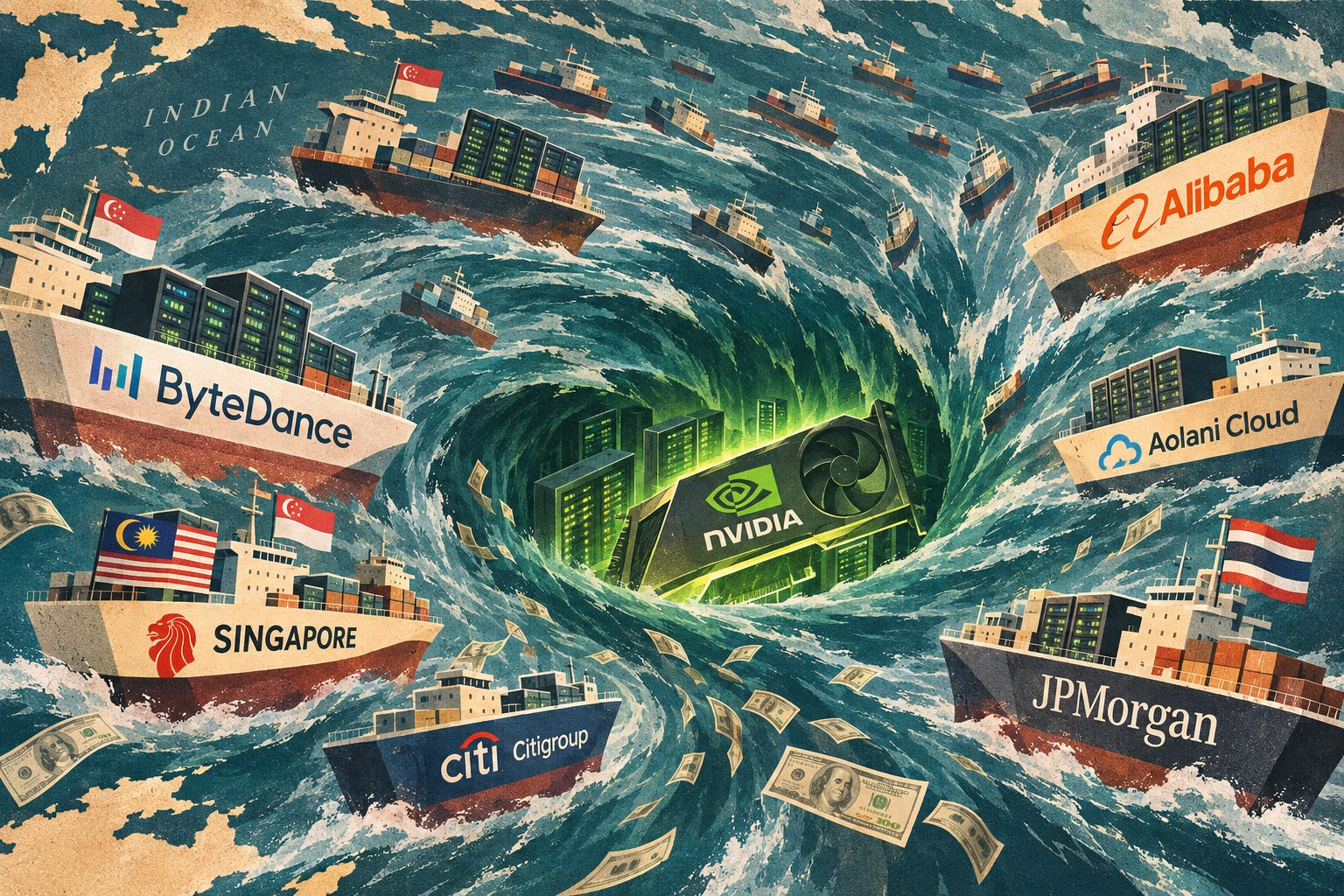
It’s hard to know where to start with Nvidia. The aftermath of Jensen Huang’s exit is wide-reaching and seemingly twisting and turning on a daily basis. We wrote on Monday that this is broadly bad news for Southeast Asia and, while I hate to focus on the same topic again, things have taken a dark turn for the region after the US introduced regulation to limit remote access to chips in the region.
In a bid to seemingly close the remote access window in Southeast Asia, the US Commerce Department introduced rules that require licences for certain advanced-chip exports to Singapore, Malaysia, Indonesia, Thailand and Brazil. In addition, the interim rules mean data centres worldwide that provide large amounts of computing power to China-based companies will need US authorisation, although there are some exceptions.
This falls within the jurisdiction of the US government where it involves US chips or even foreign-made products that incorporate controlled US items. Broadly, also, it reflects America’s efforts to restrict Chinese companies from accessing the latest US technology.
We know this is happening in Southeast Asia. We wrote how two Singapore-based businesses count ByteDance as their anchor customers. DayOne, one of the duo, is planning for an IPO at a valuation that could touch $20 billion—planning being the key word here. The other, Aolani Cloud, has seen a $480 million loan to buy Nvidia GPUs stall after five lenders reportedly reconsidered their commitment following the US action.
We know Nvidia abruptly stopped disclosing its revenue from Singapore one year ago. The FT reports that the US firm booked $104 billion in revenue through Singapore in 2025. That accounted for nearly half of all global revenue, thanks to annual growth of more than 70%. Was the company worried the number would raise questions and attract attention? It certainly appears so.
This week’s regulation from the US is an interim rule while the Remote Access Security Act (RASA) makes its way through Congress, having already passed The House. It comes into effect tomorrow (19 November) and already it is spooking the region.
Beyond the skittish reaction to Aolani Cloud’s proposed financing, other lenders are said to be reconsidering commitments and potential deals.
Thailand’s Foreign Minister was among the first politicians to speak out, warning that the new US restrictions could undermine his country’s plans to become a data centre hub. Obvious, but the sentiment will be shared across Southeast Asia and beyond.
Nvidia itself has warned customers that the RASA could massively impact its customers, and the interim action is likely to be similarly disruptive. It says it has already stopped selling its chips to customers who rent more than 50% of their GPUs to Chinese businesses.
What edge does Southeast Asia have if it is unable to give Chinese customers access to chips they can’t get at home? And will the US government budge?
Malaysia’s CoinGecko sells majority stake to Solana
CoinGecko, the Malaysia-based company that aggregates cryptocurrency prices and data, has an exit of sorts after it was confirmed that the Solana foundation acquired a majority share of the business. There’s no price attached to the deal, but you’d imagine it is a decent one given the size of CoinGecko’s influence and reach.


Crypto is in a bear market, but CoinGecko’s data is used by businesses across the industry to ensure accurate pricing, analytics and more. It sells access via APIs and licensing.
For a clue on just how big that opportunity is, Binance acquired its rival CoinMarketCap back in 2020 for around $400 million. The industry has grown exponentially since then. The total crypto market has grown roughly 12-fold, from about $181 billion to $2.19 trillion, with new participation from the institutional traders and traditional financial institutions which CoinGecko serves.
I wrote about CoinGecko’s impressive run back in 2020, and the company hardened its monetisation and grew its presence since then. (Six years ago feels like yesterday!) Of course, the best exit comes at the top, but that’s next to impossible to time.
Solana is, in my opinion, a great custodian. I’ve written about Solana’s own rise and struggle before, and the foundation generally takes a long-term view, particularly compared to its peers, and it is respectful of founders and builders.
Binance leaned on CoinMarketCap pretty heavily, installing its own team and allegedly influencing prices and data to boost its numbers. I’d be surprised if that happens with CoinGecko and Solana, but time will tell how the collaboration shapes up. But this is a great exit for a bootstrapped company in Southeast Asia.
Deals
Japan’s Taisei is putting $150 million into an AI and robotics fund managed by Pegasus Tech Ventures, with an eye on technology that could ease construction labour shortages through 2036 [Bloomberg]
India’s Bharat Semi raised $24 million in seed funding to develop AI-enabled image sensors and expand into the US, where it has secured design wins ahead of targeted commercial production in 2027 [TechCrunch]
Oister Global launches a 6 billion rupee ($64 million) fund for Indian growth-stage deep tech companies, comprising a 4 billion rupee ($43 million) base and a 2 billion rupee ($21 million) greenshoe option [Moneycontrol]
Earnings
Baidu reported quarterly revenue in line with estimates as its AI business grew 37%, including a 94% jump in AI cloud infrastructure revenue to 8.2 billion yuan ($1.23 billion), offsetting weakness in advertising [Reuters]
JD.com reported a 22.6% rise in third-quarter net income to 6.5 billion yuan ($975 million), below analysts’ 6.97 billion yuan ($1.05 billion) estimate, while revenue rose to 309.6 billion yuan ($46.4 billion) [SCMP]
AI and Chips
Huawei’s Horinger AI data centre in Inner Mongolia has an estimated 7% of the computing capacity of the Colossus 2 campus in Tennessee, according to Epoch AI, reflecting the constraints facing China’s AI infrastructure [Epoch AI]
SK Hynix plans to open an 874.6 billion won ($654 million) chip testing facility at South Korea’s Yongin Semiconductor Cluster in May, giving smaller equipment suppliers a place to validate products before commercial deployment [Bloomberg]
Samsung plans to expand its Austin fab to make STM32V8 microcontrollers for SpaceX’s Starlink satellites, with production targeted for 2030 [Seoul Economic Daily]
Alibaba has launched Qwen4-Max, a closed-weight AI model it says beats Anthropic’s Claude Fable 5.1 and Moonshot’s Kimi K3.1 Pro in coding benchmarks, with safeguards against cyberattacks and chemical, biological, radiological and nuclear threats.[Qwen]
Moonshot AI is taking its Kimi models into biology, chemistry and pharmaceutical research as the Chinese startup applies AI reasoning to scientific discovery [SCMP]
A planned US-backed AI hub in the Philippines faces opposition over potential job losses, pressure on local resources and concerns about sovereignty [NYT]
Google plans to give Japan’s government and major infrastructure operators early access to its latest AI models for cybersecurity, expanding a programme previously focused mainly on US agencies and security companies [Nikkei Asia]
Chinese companies are using outputs from leading US AI models to train domestic systems through distillation, with firms automating data generation and employing specialists to prepare the material [Reuters]
Chinese state-backed and criminal groups are using AI for espionage, vulnerability research and influence operations, Google says, as automated tools take on reconnaissance and other tasks [The Record]
China has launched a 1 billion yuan ($150 million) computing cluster in Shantou using Huawei’s Ascend 950DT chips, with plans to provide AI computing power to overseas customers from a China Telecom submarine cable landing station [SCMP]
Policy
Meta has adjusted Instagram’s recommendations in India to reduce sexually suggestive and violent content after government pressure over posts that could incite violence or disrupt public order [Reuters]
India is seeking more than $150 million in back taxes from Xiaomi’s local unit, accusing the smartphone maker and former contract manufacturer Flex of failing to disclose royalty arrangements [Reuters]
The Trump administration plans to restrict imports of Chinese optical transceivers used in data centres on national security grounds, despite opposition from Amazon, Google and Meta [Reuters]
Taiwan will require ride-hailing platforms to obtain approval under the same rules as taxi operators by 17 November 2027, with fines of up to NT$25 million ($760,000) and possible suspension for companies that fail to comply [Focus Taiwan]
Malaysia’s communications regulator is seeking details from Anthropic about an alleged foreign-linked political influence campaign targeting Malaysian users that used Claude to build targeting systems, fake accounts and fabricated news sites [The Star]
In other news:
China is bringing AI, robotics and programming into classrooms as it aims for universal AI literacy by 2030, though teaching standards and assessment remain uneven [Reuters]
We wrote about Kakao’s plans to spin out its AI business, despite shareholder resistance it is going ahead with plans to put KakaoTalk into a new AI business, Kakao AI, while grouping its internet and mobile operations under Kakao X early next year as it restructures around AI [Bloomberg]
Reliance is in talks with Indian manufacturers, startups and industrial groups to build a 1,600-satellite broadband network by 2035, offering to fund infrastructure as it pursues a domestic alternative to Starlink [Bloomberg]